Pinmi
Get a Quote
Pinmi
August 2026 · 7 min read
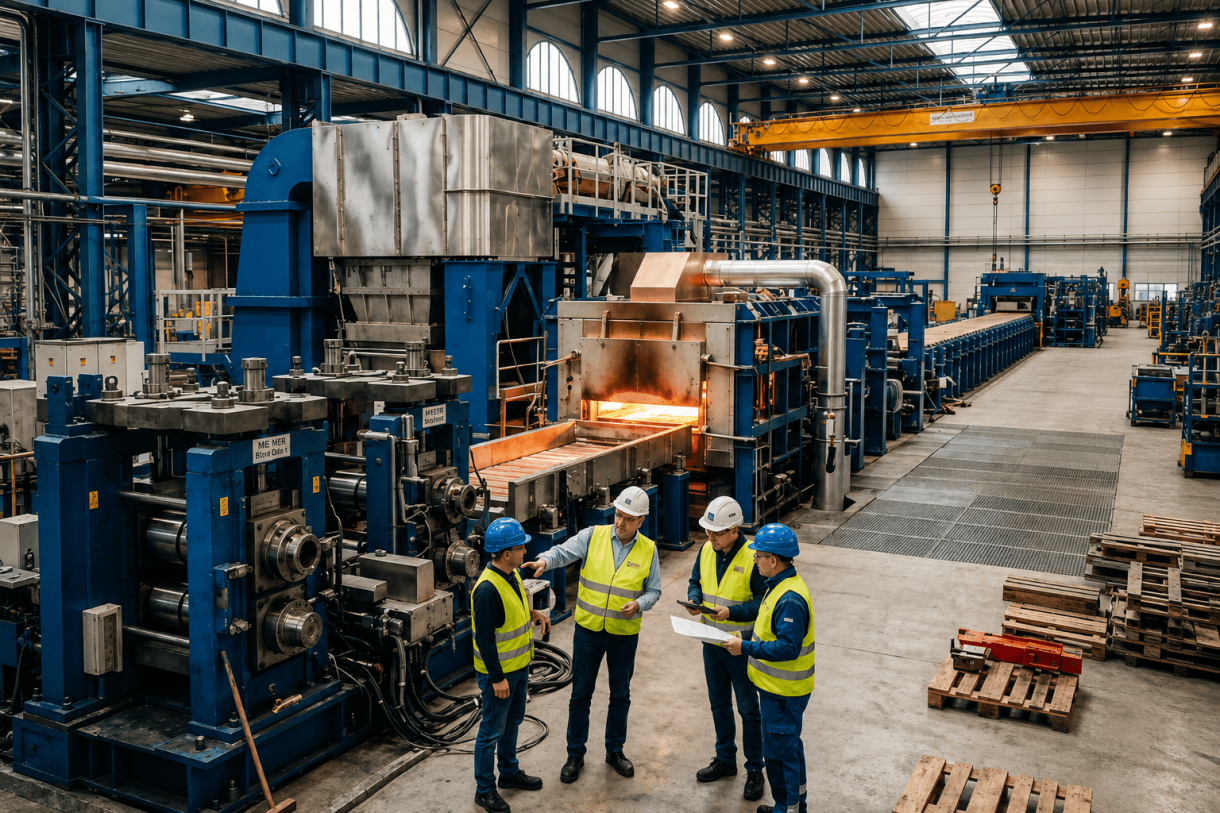
Another important project milestone has been reached: a new copper continuous casting and rolling line has been delivered to the customer’s factory and positioned beside the existing aluminum rod plant.
This arrangement brings two major non-ferrous rod production capabilities into one industrial site. With the aluminum rod line already forming part of the customer’s manufacturing operations, the addition of the copper CCR line creates a broader production platform for serving wire, cable, electrical, construction, automotive, and related markets.
Although copper and aluminum require separate metallurgical processes and production controls, locating the two plants next to each other can offer practical advantages in factory planning, utilities, logistics, maintenance, and future business development.
The new copper CCR line represents more than the delivery of another set of machines. It is an expansion of the customer’s raw-material and finished-product portfolio.
An aluminum rod plant allows a manufacturer to supply lightweight, cost-effective conductor material for applications such as power transmission, building wire, overhead conductors, and industrial cables. Copper rod serves markets that require high electrical conductivity, reliable connection performance, excellent ductility, and suitability for fine wire drawing.
By operating both production capabilities at the same site, the customer can respond to a wider range of market requirements. The factory can develop separate product programs for copper and aluminum while using its existing knowledge of rod production, coil handling, quality inspection, and downstream wire processing.
The investment can also make the plant more flexible when market demand changes. Rather than depending on a single non-ferrous material, the manufacturer gains the ability to support different customer groups and conductor applications.
CCR stands for continuous casting and rolling.
A copper CCR line converts molten copper into continuous copper rod through an integrated production process. Instead of casting separate billets, allowing them to cool, reheating them, and rolling them in independent stages, the CCR process connects casting and rolling in one coordinated line.
A typical process may include:
After molten copper is cast into a continuous bar, the bar enters a sequence of rolling stands. Each stand gradually reduces and reshapes the material until the required copper rod diameter is achieved.
The finished rod is cooled, treated, and formed into coils for storage, transportation, or further processing in a rod breakdown machine.
The copper and aluminum lines remain technically independent because the two metals have different melting temperatures, oxidation behavior, casting conditions, rolling requirements, and quality standards.
However, placing them in adjacent production areas can simplify factory management.
The two plants may use common factory resources such as:
Shared infrastructure does not mean mixing the two processes. Copper and aluminum materials, tools, cooling systems, production routes, and quality records should remain properly controlled to prevent contamination and operational errors.
The benefit comes from better use of the overall industrial site.
Both rod lines handle large quantities of raw material and finished coils. A coordinated factory layout can improve material flow from receiving to production, inspection, storage, and shipment.
Clearly defined transport routes can reduce unnecessary handling and help forklifts, coil cars, cranes, and trucks operate more safely.
Finished copper and aluminum rod coils can also be managed through a central dispatch area while remaining separately identified and stored.
Casting and rolling plants contain mechanical, hydraulic, electrical, cooling, and automation systems. Locating the two lines in the same industrial complex allows the customer to establish a centralized maintenance team with relevant experience.
Technicians can share diagnostic instruments, lifting equipment, machining resources, planned-maintenance procedures, and selected general-purpose spare parts.
The line-specific components and metallurgical procedures must still be managed separately, but a common maintenance organization can improve response time and reduce duplicated resources.
The arrival of the copper CCR equipment marks the transition from manufacturing and logistics to site execution.
Before production can begin, the project normally moves through several important stages.
Each shipping package should be checked against the packing list. Machine sections, control cabinets, auxiliary systems, tools, spare parts, and technical documents must be identified and inspected for transport damage.
Keeping an accurate equipment inventory helps the installation team follow the planned erection sequence.
The installation team should verify foundation dimensions, anchor positions, center lines, floor elevations, operating clearances, maintenance access, and material flow.
Correct alignment is particularly important between the casting machine, cast-bar preparation equipment, rolling mill, cooling section, and coiling system.
Small alignment errors at the beginning of the line can create larger operating problems during continuous production.
After the main machines are positioned, the project moves to mechanical assembly and connection of:
The copper line’s utility systems should be clearly separated from those serving the aluminum plant where process conditions require independent control.
Commissioning normally starts with component-level inspections and no-load tests. Motors, pumps, valves, sensors, drives, emergency stops, alarms, and safety interlocks are checked before material enters the line.
Individual equipment is then tested as part of the complete production sequence. Casting speed, rolling speed, cooling, tension, and coiling must work together.
Only after the line operates reliably under controlled conditions should trial production begin.
Operating both plants at one site requires disciplined material and quality management.
Copper contamination in aluminum products—or aluminum contamination in copper products—can affect material performance and customer acceptance. The plant should establish dedicated zones for raw materials, process tools, scrap, finished coils, and laboratory samples.
Recommended practices include:
Visual identification, floor markings, coil labels, and digital production records can help prevent material mix-ups.
Copper rod produced by a CCR line can be used as feedstock for rod breakdown and wire drawing equipment. It may eventually become building wire, power cable conductors, automotive cable, magnet wire, flexible conductors, communication cable components, and other electrical products.
Aluminum rod can support overhead conductors, building cables, power distribution products, and applications where lower weight and material economy are important.
Having access to both rod materials allows the customer to serve a more diversified downstream market. It also creates opportunities to coordinate production planning with wire drawing, stranding, extrusion, and cable manufacturing operations.
The delivery of the copper CCR beside the aluminum rod plant reflects a practical approach to industrial growth: build on existing infrastructure, expand the product range, and create a production site capable of supporting multiple non-ferrous conductor markets.
The success of the project will depend on more than the machinery itself. Careful installation, accurate alignment, stable utilities, disciplined material separation, operator training, and responsive technical support will all contribute to reliable commercial production.
PINMI Group will continue to support the project through the next stages, from installation planning and equipment commissioning to trial production and process coordination.
For manufacturers considering a copper CCR line, an aluminum rod plant, or an integrated non-ferrous rod production site, the first step is to define the raw material, required rod specification, target capacity, utility conditions, available factory space, and downstream application.
Contact PINMI Group to discuss your project requirements and develop a production-line configuration suited to your market and long-term investment plan.

Share your capacity, raw material and site conditions — we'll come back with a process route, equipment selection and a turnkey path to production.


No.310–311 National Road, Quanshan District, Xuzhou City, China