
Pinmi
Get a Quote
Pinmi
August 2026 · 7 min read
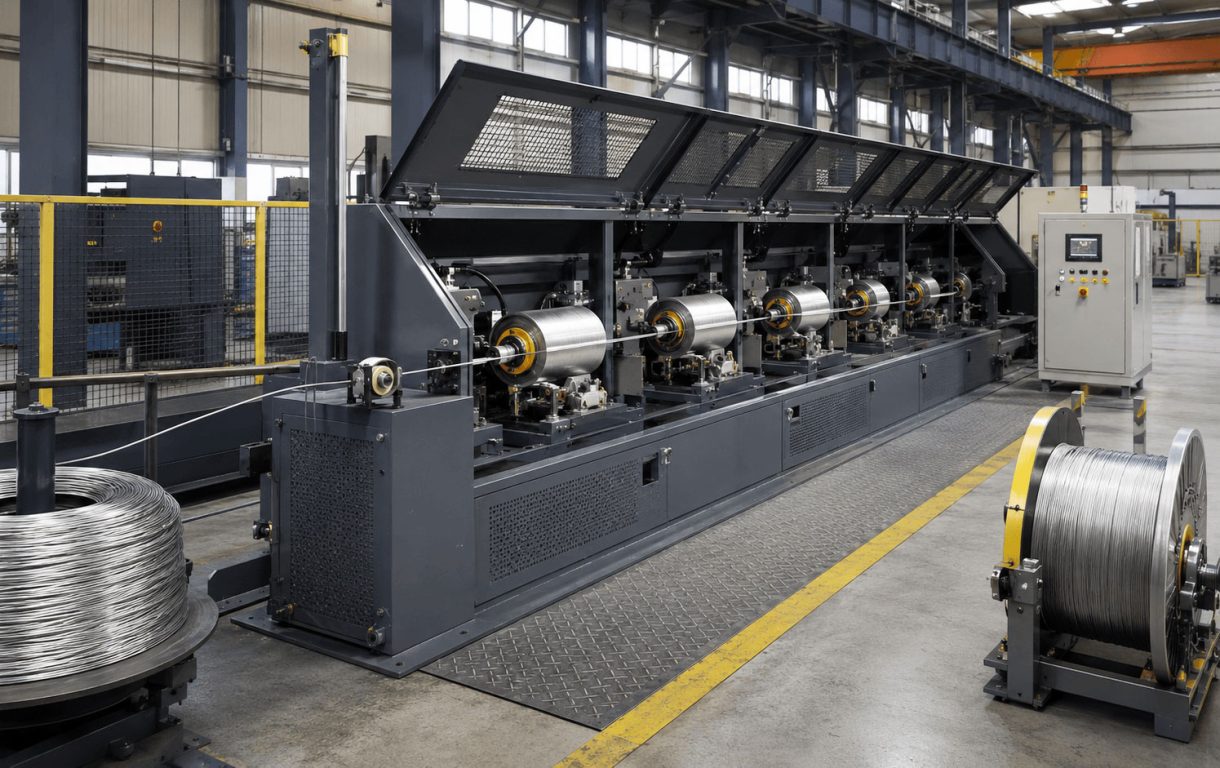
A reliable wire drawing machine is essential for manufacturers that need to produce metal wire with a controlled diameter, smooth surface, and consistent mechanical properties. Whether the finished wire is used for electrical cables, automotive components, welding products, springs, fasteners, wire mesh, or other industrial applications, the performance of the drawing equipment directly affects product quality and production efficiency.
However, not every machine is suitable for every material or production target. Wire type, inlet and outlet diameter, drawing speed, cooling method, tension control, and automation level must all be considered before purchasing a new production line.
This guide explains how a wire drawing machine works, introduces the main machine configurations, and highlights the factors international buyers should evaluate before making a decision.
A wire drawing machine is industrial equipment used to reduce the diameter of metal wire by pulling it through one or more drawing dies. Each die has an opening that is smaller than the incoming wire diameter. As the wire passes through the die, its cross-sectional area decreases while its length increases.
For a large diameter reduction, the wire normally passes through several dies in sequence. Instead of attempting the complete reduction in one step, the machine gradually brings the wire to the required final diameter.
The drawing process can also improve dimensional consistency and surface quality. Depending on the material and reduction ratio, intermediate or continuous annealing may be required to restore ductility and prevent excessive work hardening.
Common materials processed by wire drawing equipment include:
Because these materials have different mechanical properties, the machine, dies, lubricant, cooling system, and drawing schedule should be selected according to the actual application.
A typical production process starts with a payoff system that supplies wire rod or previously drawn wire to the line. The material may first pass through cleaning, descaling, or surface preparation equipment.
The wire is then pointed so that its leading end can enter the first drawing die. A capstan or drawing drum provides the pulling force required to move the wire through the die. In a multi-pass wire drawing machine, the material continues through several dies and capstans until it reaches the specified diameter.
Lubrication reduces friction between the wire and dies, while the cooling system controls the heat generated during continuous drawing. At the end of the line, the finished wire is collected by a take-up unit, spooler, or coiler.
Stable production depends on the coordination of several systems:
If these systems are not properly matched, manufacturers may experience wire breakage, diameter variation, scratches, die wear, unstable coils, or reduced production speed.
A straight-line machine allows the wire to travel directly from one drawing block to the next. It is commonly selected for high-output steel wire production and applications requiring efficient continuous operation.
Its advantages can include high drawing speed, stable tension control, flexible die arrangements, and compatibility with automated production lines.
A pulley-type wire drawing machine uses guide pulleys between drawing stages. Its relatively straightforward structure can make operation and maintenance convenient.
This configuration is often used for medium and fine wire production when buyers require a practical balance between investment cost, capacity, and maintenance requirements.
In a wet drawing machine, the dies and part of the drawing system operate with liquid lubricant or coolant. The liquid helps reduce friction, control temperature, and protect the wire surface.
Wet drawing is especially suitable for fine wire and applications requiring a smooth finish. It is frequently used for copper, aluminum, steel, stainless steel, and other small-diameter wires.
A vertical drawing machine generally uses one large drawing block and is suitable for heavy wire, larger inlet diameters, or applications involving a significant pulling force.
The best configuration depends on the raw material, target diameter, required output, available factory space, and downstream process.
Start by confirming the metal grade and its tensile strength, ductility, surface condition, and work-hardening behavior. A machine designed for soft copper wire may require a different drawing system from equipment intended for high-carbon steel.
Providing the supplier with complete material information helps prevent incorrect equipment selection.
The required diameter range determines the number of drawing passes, die sequence, capstan size, motor power, and possible need for annealing.
Buyers should clearly specify:
A higher maximum speed does not automatically guarantee higher usable output. Actual productivity also depends on wire diameter, material properties, line stability, spool changes, and the performance of the payoff and take-up units.
A properly configured wire drawing machine should deliver stable production at the required operating speed, rather than only achieving a high speed under ideal test conditions.
Accurate tension control is important throughout the drawing line. Excessive tension can lead to wire breakage, while insufficient or unstable tension may produce dimensional variation and poor winding.
Modern control systems can coordinate multiple motors and drawing blocks, helping maintain consistent wire flow during acceleration, normal production, deceleration, and stopping.
Drawing generates friction and heat. Without effective lubrication and cooling, the dies may wear faster and the finished wire may develop surface defects.
The appropriate system depends on whether the process is dry or wet, as well as the material, drawing speed, and required surface quality.
The main drawing machine is only one part of the complete line. The payoff must feed material smoothly, and the take-up system must produce stable, well-arranged coils or spools.
When comparing quotations, buyers should check whether auxiliary equipment, control cabinets, safety guards, dies, spare parts, and installation services are included.
Easy access to dies, capstans, bearings, lubrication points, and electrical components can reduce maintenance time. Buyers should also evaluate documentation, spare-parts availability, remote support, installation guidance, and operator training.
For international projects, dependable after-sales communication is often as important as the initial machine price.
Selecting the right wire drawing machine can help a manufacturer achieve:
Instead of choosing equipment based only on price, buyers should consider the total operating cost, expected output, energy consumption, maintenance requirements, and long-term production stability.
To receive a suitable technical proposal, prepare the following information:
The more complete the project information, the more accurately the machine can be configured.
A wire drawing machine should be selected as part of a complete production process, not as an isolated piece of equipment. Material characteristics, reduction schedule, line speed, tension, cooling, winding, and downstream operations must work together to produce consistent wire efficiently.
PINMI Group can help international buyers evaluate their wire production requirements and identify an appropriate equipment configuration. If you are planning a new production line or upgrading existing machinery, contact our team with your material, diameter range, capacity, and electrical requirements to discuss a tailored solution and quotation.
Company
August 2026 · 8 min read
Company
August 2026 · 8 min read
Company
August 2026 · 8 min read
Company
August 2026 · 8 min read
Event
August 2026 · 7 min read

Share your capacity, raw material and site conditions — we'll come back with a process route, equipment selection and a turnkey path to production.


No.310–311 National Road, Quanshan District, Xuzhou City, China